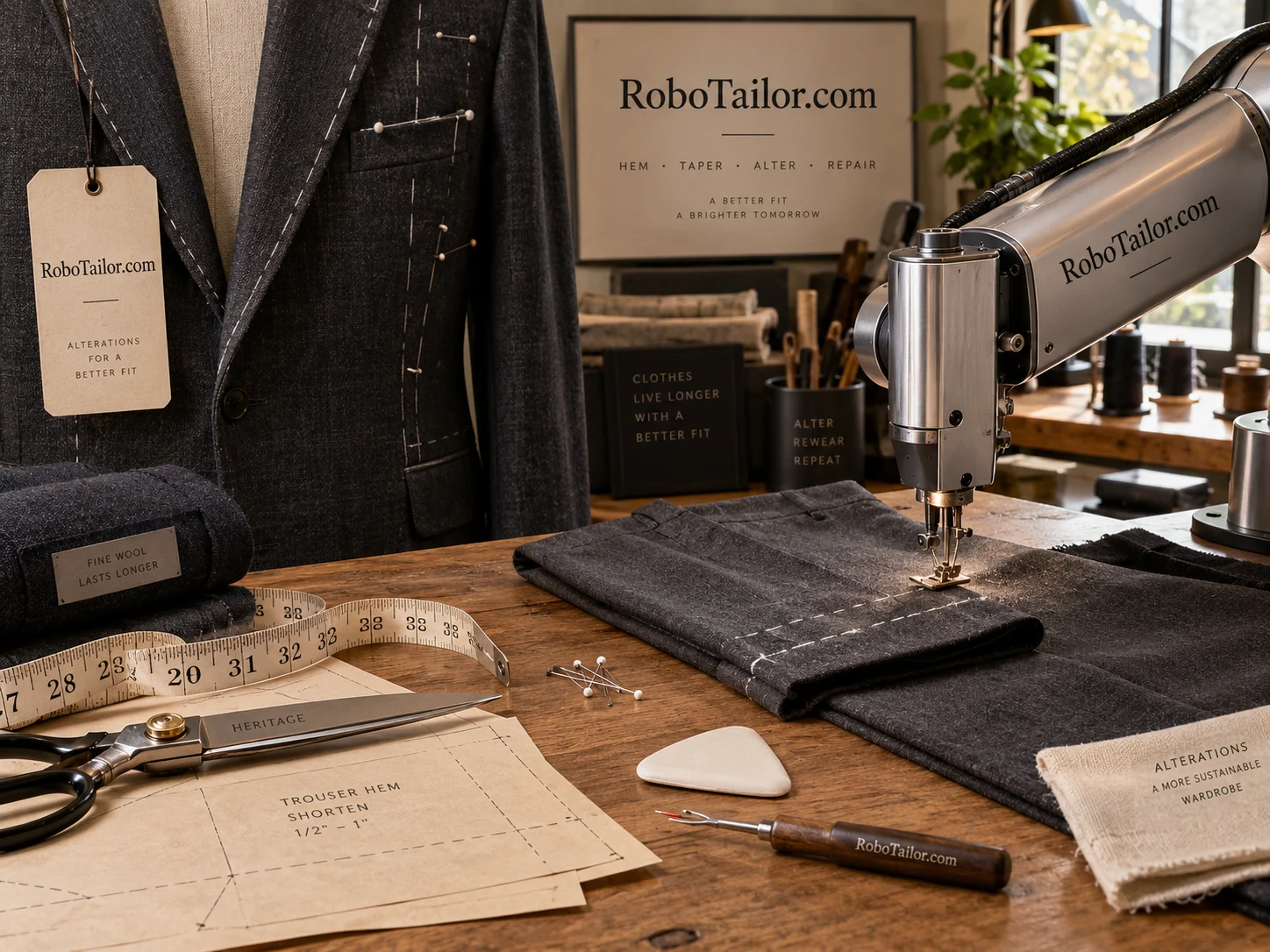
An alterations counter sees garments with history. A trouser leg may have been shortened before. A jacket lining may hide an earlier repair. A customer may arrive with a deadline and only a vague description of the desired change. A robotic alterations brand has to accommodate that reality before it can make useful promises about speed.
RoboTailor.com could name a shop or small network that uses automation for carefully selected alterations. The concept below is illustrative. Its first offer would be a limited menu with clear inspection and acceptance rules, supported by a person who can explain when a garment needs a different approach.
Start at the counter, not the machine
The customer is likely to care about the garment’s appearance, the collection date and the possibility of an adjustment. Lead with those concerns. Explain which work the shop accepts, what needs an inspection and when the collection estimate becomes firm. Avoid asking a visitor to choose between machinery types before anyone has seen the garment.
A useful first menu might focus on straightforward trouser hems in selected constructions. The operator would decide the supported materials and finishes after testing. Jacket shoulders, delicate embellishment and unfamiliar technical fabrics could remain assessment-only work. A small menu lets staff give a better answer than an expansive list with an exception attached to every line.
The name fits a service in which customers can see the connection between tailoring knowledge and selected automated work. Local trust would still come from careful intake, legible tickets and a finished garment that matches the agreed instruction. Put the address, service area and appointment arrangements beside the technical story once those operating details exist.
Define the acceptance boundary
Before committing to a hem, inspect the existing finish, available fabric, seam intersections and condition. Record the requested finished length in a consistent way. If the customer brings shoes for a fitting, note that context. A verbal instruction such as “take a little off” needs clarification before the garment reaches a cutting table.
Attach a unique ticket to the garment and keep accessories together. The ticket should say who approved the work, what the finished result should be and whether any original feature must be preserved. Photographs can help with condition records when the customer understands their purpose. They should supplement the written instruction rather than become an unsearchable substitute for it.
For general development context, NIST’s manufacturing robotics testbed includes work on retasking and performance evaluation. That is a useful reminder to evaluate changeovers and complete tasks. It is not a claim that any particular tailoring machine is suitable for a shop’s mixed intake.
Schedule the whole job
A collection promise has to account for assessment, preparation, machine availability, pressing and inspection. A fast sewing step does not remove the other steps. Give the front desk visibility into work that is waiting for customer clarification or an experienced operator. Otherwise those garments can quietly occupy capacity while the schedule looks available.
Use an exception area with an owner and a next action. “Needs review” is incomplete. “Fitter to confirm length with customer before cutting” tells the next person what to do. If an item misses the last inspection window, the counter should know before the customer travels to collect it.
The business can offer different service windows only when its staffing and evidence support them. A same-day category, if introduced, should have a clear acceptance cutoff and a narrow scope. The proposed brand does not need an invented throughput number to sound credible. It needs a promise the operator can explain and keep.
A worked service example
Imagine a customer bringing two pairs of trousers. One has an ordinary folded hem; the other has a finish the shop has not validated for its automated route. Staff accept the first for the standard service and quote the second only after specialist review. Both garments receive separate instructions, even though they arrived together.
The standard pair moves through marking, preparation, the supported sewing operation and a final check. If the inspection reveals an uneven result, the ticket returns to a named person with the failed check recorded. The specialist pair remains visible in a separate assessment queue. The customer receives an explanation of the different paths at intake, rather than discovering the distinction at collection.
That simple separation is also valuable for training. A newer counter employee can learn the supported categories without being expected to diagnose every construction. The escalation rule protects the garment and gives the experienced tailor a defined review task.
Build distribution through a useful partner
A nearby clothing retailer is a plausible first referral partner. Its customers already have garments that need length or fit changes. The arrangement should specify where the fitting happens, who provides the collection estimate and who handles a complaint. Sending a bag of garments between businesses without shared instructions invites confusion.
Start with a small set of accepted services and a scheduled handoff. Provide a sample ticket and an example of an item that must be referred for review. Retail staff need those practical details more than a broad presentation about the future of robotics. Expand the arrangement when both sides understand the daily workload.
Prepare the business behind the sign
Execution would require trained staff, suitable equipment, validated service categories, garment handling space and a reliable customer record. Local operating and equipment requirements would need review before launch. The concept also needs a policy for work that cannot proceed after inspection and for garments that remain uncollected.
For a domain inquiry, describe the intended geography, service mix and operating team. A single appointment counter and a multi-location alterations network are different proposals. RoboTailor.com could support either, but the acquisition conversation becomes much more useful when the first shop’s customer and menu are already in view.