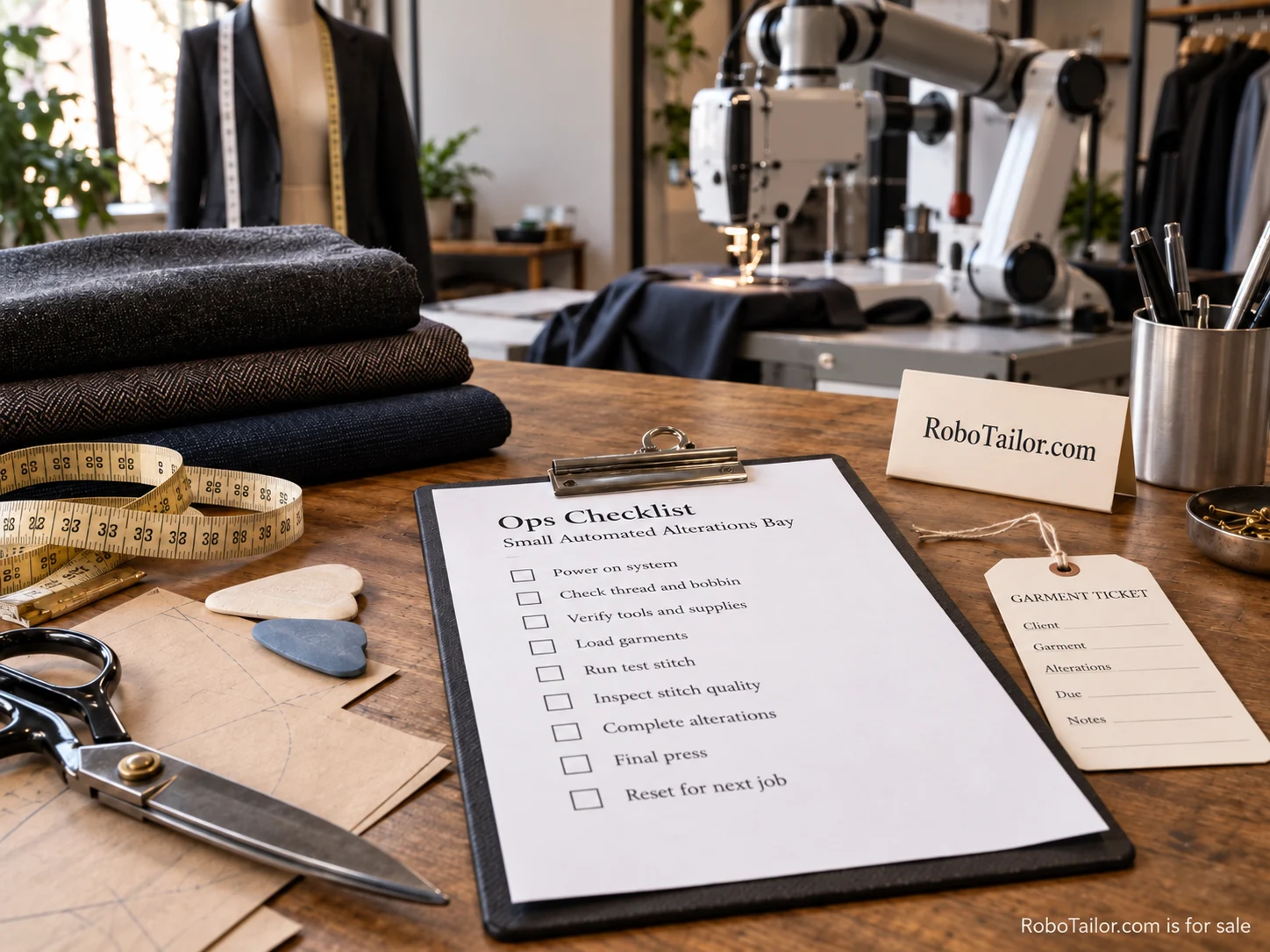
A small automated alterations bay needs more than a list of jobs in arrival order. Some garments are ready to run. Others still need a fitting decision, preparation or review of an unfamiliar construction. Putting them into one queue makes the machine schedule look clear while the work itself remains uncertain.
Build the day around readiness and handoffs. The checklist below is an illustrative planning aid for a shop evaluating selected automated operations. It is not an equipment operating procedure. Installation, safety, maintenance and recovery instructions must come from the appropriate qualified people and documentation for the actual system.
Intake: agree on the finished result
At the counter, identify each garment separately. Record the customer reference, requested alteration, relevant condition and agreed collection arrangement. If a fitting is needed, do not treat a rough verbal estimate as an approved cutting instruction. The garment should remain in assessment until the necessary decision is made.
Use a ticket that stays associated with the item throughout the shop. Loose accessories need a named place and a reference to the same ticket. Staff should be able to answer where an item is without relying on the memory of the person who accepted it. That becomes especially useful when shifts change or a customer asks about only one item in a larger order.
Before accepting a standard service, compare the garment with the supported categories. An unfamiliar fabric or altered construction may require specialist review. Give the counter a short escalation rule with examples. It is easier to train someone to recognize “needs review” than to expect every employee to diagnose every garment immediately.
Preparation: establish a ready state
A job is ready for the bay only when its instruction is approved, its preparation is complete and the proposed operation is supported. Define those checks in writing. The person preparing the garment should mark completion, identify the instruction revision and note any concern that the operator needs to see.
Keep ready work physically distinct from work awaiting a decision. The distinction does not require expensive software. Clearly marked locations and legible tickets can support a small pilot. A digital system becomes useful when it preserves the same distinction and makes it easier to find a job, rather than merely replacing paper with a screen.
If preparation reveals a problem, move the item to an exception state with a specific reason. Do not leave it near the machine in the hope that the operator will infer what is wrong. A ticket saying “existing seam needs tailor review before proceeding” creates a task. A garment sitting silently on a table creates a guess.
Planning: reserve complete blocks of work
Reserve time for setup, operation, inspection and the relevant handoffs. The appropriate block size depends on the equipment and actual work. Start with observed times from the proposed process, then review the schedule as the team learns. Avoid publishing collection promises based only on a supplier’s machine cycle.
Group work by meaningful setup requirements when doing so helps the operation. Customer deadlines and garment readiness still matter. A batch that is convenient for the machine may be unhelpful if it delays several ready orders behind one unresolved item. Make the tradeoff visible to the person responsible for customer commitments.
Keep a modest amount of uncommitted space until the shop has evidence about variability. The point is not to choose an arbitrary utilization target. It is to avoid treating every minute as available when recovery, questions and inspection already consume part of the day. Record the reasons for interruptions so future planning improves.
Handoff: let the operator accept the job
The operator should confirm the ticket, prepared item and intended operation before work begins. A handoff is complete when the receiver has the information needed to proceed. Merely placing a garment beside the equipment does not establish that the instruction is understood or supported.
Use the equipment’s approved setup and operation procedures. If the ticket conflicts with the prepared garment, stop and route the question to the named owner. Do not ask the operator to improvise a customer decision. The cost of a short clarification is visible; the cost of an incorrect alteration may emerge much later.
NIST describes robotics research involving retasking, collaboration and performance evaluation. For a shop, those are useful areas to ask about during equipment evaluation. The research page does not provide an operating checklist for a particular alterations installation, so use the actual equipment documentation for those instructions.
Inspection: preserve a separate release gate
After the supported operation, inspect the garment against the agreed result. Record who performed the check and any issue that prevents release. Pressing and finishing may have their own place in the sequence. The shop should define that order for each accepted service instead of assuming every garment follows the same path.
A completed machine run is not the same as a garment ready for collection. Keep those statuses separate. The front desk should see the released status only when the required checks are complete. That prevents a customer message from being triggered by an intermediate event that still has work behind it.
When an item fails inspection, record the failed criterion and route it to a named person. Preserve the first result after rework. Otherwise the daily record may suggest that every job passed immediately, concealing the effort that actually consumed capacity. A useful review includes both the final outcome and the path taken to reach it.
Exceptions: give every waiting item a next action
Create a short set of exception reasons: customer clarification, unsupported construction, preparation issue, equipment review and inspection rework might be sufficient for a pilot. Assign an owner and a review time. The categories should help staff act, not become a complicated classification exercise.
At a planned point during the day, review the waiting items. Resolve what can be resolved, contact the appropriate person and update the collection expectation when needed. An exception queue without a review habit becomes storage. A review habit without visible tickets depends too heavily on memory.
An equipment interruption needs its own response according to approved procedures. The scheduling record can identify affected orders and their owners, but it should not invent technical recovery instructions. Customer-facing staff need the likely effect on commitments once the operator has a reliable assessment.
A sample day to walk through
Imagine three ready trouser jobs, a jacket awaiting approval and an item that failed inspection. The morning review assigns the failed item to a tailor and leaves the jacket outside the committed machine queue. The three ready jobs can then be planned with their setup and inspection work included.
Later, the jacket approval arrives. Its next step is preparation, so it does not immediately displace ready work. If it becomes ready in time for an available block, the scheduler can place it there. If not, the front desk updates the collection discussion based on the actual route. The schedule remains a representation of work, not a wish list.
Close the day with usable evidence
Compare the planned and actual path for a few jobs. Note where they waited, which instructions needed clarification and what inspection found. Look for one repeated cause that can be addressed with a clearer rule, better preparation or a different acceptance boundary. Avoid changing several things at once if the team then cannot tell what helped.
For a first action, draw five columns: assessment, preparation, ready, inspection and released. Place each current garment in exactly one column and add an owner to every blocker. The empty spaces and crowded columns will reveal more about the next operational improvement than an unsupported promise of faster sewing.